
Image: Gruber in the studio at Arlesheim.


Alfred Gruber and Friends
Having travelled from the Danube to the Humber, the Austrian-born sculptor Alfred Gruber settled at Welton in East Yorkshire in 1969. Our exhibition tells the story of the artistic journey of this exceptional artist, whose work was invariably experimental, emerging from an exploration of materials and sculptural form. The results, which were often interactive, could be funny, forceful and at times painfully direct.
Our journey begins at the art school in Linz, with Gruber's introduction to modern sculpture, 'degenerate' art and fellow Austrian artists. From Linz, we travel to Switzerland, with its modern churches and challenging sacred art. In 1968 - the year that 'rocked the world' - Gruber was in Prague. He arrived during Prague Spring when a new administration brought a spirit of optimism and loosened the grip of Soviet power for a brief time.
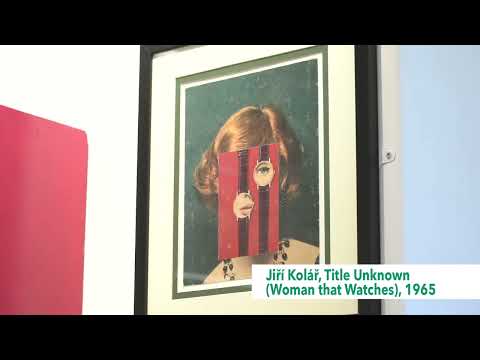
Throughout his journey from the Danube to the Humber, artistic friendships and partnerships were forged. They included modern Swiss architects and artists including the young David Weiss. Despite language, social and cultural divides, with a shared passion for art, Gruber formed friendships with Czech artists like Cenek Prazak and Jiri Kolar. But it was the artistic and personal relationship with the English-born sculptor Jacqueline Stieger that ultimately steered him towards Yorkshire.
Image: Gruber in the studio at Arlesheim.

Image: Gruber, Wearing the Trousers, 1971 (front).

Image: Wearing the Trousers, 1971 (back).

Image: Peter Kubovsky, Untitled, 1959
On leaving art school in 1952, Gruber embarked on a European tour, which included a trip to England and the studio of Henry Moore. Eager to progress as a sculptor, with few opportunities in Austria, he took a bike ride to Switzerland in search of work. After a short stint lettering tombstones, he settled at Arlesheim near Basel, working as assistant to Albert Schilling - a sculptor renowned for innovative sacred or church art.
Throughout the 1950s and early '60s, the use of modern art within the church was a topic of heated debate. However, Schilling secured approval and ran a successful workshop. But the busy workshop left little time or space for Gruber's independent work, so he rented a small studio and began developing his unique style. In 1961 he created Glorreicher Christus, a rebellious work condemned as 'perverse, scandalous and disgusting'. Nonetheless, Gruber's challenging approach appealed to several modern church architects who commissioned his work, including Hermann Baur and Ernst Studer.
Alongside sacred work, Gruber was exploring movement and abstract form, creating challenging works like Blind Warrior. Over time, he progressed from symbolising movement to creating interactive sculptures or kinetic 'machines' that physically moved. Like several kinetic artists, he was intrigued by the inclusion of noise or sound. He befriended Dr Ernst Schlager, a collector and expert on Balinese music and art. Schlager's collection of Balinese musical instruments -- notably gongs and bells -- provided an unusual creative source for Gruber.

Image: Gruber, A Christian Family, 1957

Image: Gruber, Glorreicher Christus, 1961

Image: Gruber, Blind warrior, 1957 [sketch]

Image: Gruber, Blind warrior, 1957 [sketch]

Image: Gruber, Erwagbarer Vorschlag fur plastiche Glocke, 1962.

Image: Gruber, Hausuhr, c.1962.

Image: Stieger and David Weiss with Northern Dairies Screen, 1965.

Image: Jacqueline Stieger, Epitaph on Osgerby, 1965.

Image: Gruber, Da ist nichts, 1961.

Image: Gruber, David am Wachsenberg, 1962.

Image: Gruber, Akustische-optisch nach Einwurf, c.1962.
1968 was a year like no other. Described as the year when a 'spontaneous combustion of rebellious spirits' exploded around the world. A year of student protests and anti-war demonstrations. Gruber was invited to contribute to an exhibition in Prague that opened in March 1968. Now married and living in Switzerland, Gruber and Stieger made the journey to Prague to attend the opening. When they reached Czechoslovakia, Prague Spring had arrived. After years of oppressive Communist rule, Antonin Novotny -- First Secretary of the Communist Party - was removed from office. He was replaced by Alexander Dubcek, a liberal reformist offering 'socialism with a human face'. There followed a brief period of political and economic reform with less censorship and greater freedom of speech known as the Prague Spring.
Arriving at the exhibition, Gruber and Stieger were greeted by the Czech artists Cenek Prazak and Jiri Kolar. The conversation came easy and the suggestion of an exhibition for Czech artists at the Galerie Riehentor in Basel soon followed. Having settled matters with gallery owner, Trudl Bruckner, Gruber and Stieger returned to Prague and plans were made over breakfasts of goulash and coffee.
However, on 20-21 August 1968 Soviet forces invaded Czechoslovakia and Prague Spring was crushed. When Gruber and Stieger returned in January 1969 to collect exhibits for the show, the spirit of optimism, so evident on earlier trips, had disappeared. With their VW van loaded with artworks, they left Prague. Demoralized by the political situation, Cenek Prazak and his wife Anna followed them to Switzerland, where they were invited to share the Gruber-Stieger's home. Jiri Kolar also visited, and life-long friendships were forged.

Image: Gruber at the furnace in Laufen

Image: Jacqueline Stieger

Image: Jiri Kolar, Untitled (Alfred's Egg), 1969

Image: Cenek Prazak, illustration for 'A Right to Die' by Rex Stout, 1967

Image: Cenek Prazak, Signal, 1968

Image: Jan Svankmajer, Table IV, c.1968

Image: Gruber/ R. Swaine, In Place of No. 7, 1970

Image: Gruber, Portrait of an Architect, 1971

Image: Gruber, Untitled, 1971
The idea for this exhibition emerged while I was researching the Gruber-Stieger collection in preparation for a forthcoming publication. My initial interest had been sparked whilst curating the exhibition Jacqueline Stieger: Sculptor, Jeweller and Medallist for Beverley Art Gallery in 2011. Numerous people have assisted along the way. I would like to acknowledge the support of Arts Council England and the Anglo-Austrian Society (Otto Harpner Award). I am obliged to Nicole Ackermann (Cenek Prazak's only pupil) and Helena Cox for translating key documents; and to Patrizia Brumen (Neu Galerie, Graz), Richard Kunz (Museum der Kulturen, Basel), Jurgen Rath (MAERZ, Linz), Jan Skrivanek (Museum Kampa, Prague), Emma Stower (Henry Moore Foundation), Oskar Weiss, Pavla Kallistova and Jan Svankmajer for assisting with research. I am indebted to Lindon Mulcahy-Parker (Channel Robot), Patrick Cartlidge (Cartlidge Restoration), R&R Studio Ltd, and to Simon and Amelia Jefferson and Kathryn Sands for contributing to the preparation of bronze sculptures for display. I would like to thank the Czech Centre London, the Friends of Czech Heritage and the Auslandschweizer-Organisation (Organisation of the Swiss Abroad). I am particularly grateful to East Riding Museums, specifically Nial Adams, Sally Hayes, Georgia Broadley, Robert Blaine, Penny Barron, Sarah Hammond and the Friends of Beverley Art Gallery. I owe a particular debt of gratitude to the Gruber-Stieger family, especially Jacqueline Stieger for her ongoing support and encouragement, for which I remain truly grateful.
Gerardine Mulcahy-Parker
The information and images on this page are also used in a printed leaflet available to pick up at the Treasure House during the exhibition in Spring 2022. You can also download a PDF version using the link below. Please note that the download is only available in print style and will not read in the correct order online.