Health and Wellbeing

Visit your local museum for culture, learning, socialising and more.

Ways to wellbeing

Museums and galleries were created to be centres for learning and wellbeing in their communities. Visiting our museums will help you to connect, be active, take notice, keep learning and even give back to your community.

These are known as the 'Five Ways to Wellbeing', developed by the New Economics Foundation in partnership with Mind the mental health charity.

Visit our museums with family, friends or as part of a group, or take part in one of our activities to connect with someone new.

Search What's On

Enjoy walking around our exhibitions or take a stroll outside at Skidby Mill, Hessle Mill and the Chalk Walk, or Sewerby Hall and Gardens.

Plan a visit

Stop to really take in artwork, objects, or architecture, noticing colours, textures, and features.

Investigate our mindful art guides from Beverley Art Gallery.

Mindful audio guides

Take part in a talk, workshop, or tour to find out more about our collections - or have a look at our online exhibitions from the comfort of your own home.

Explore museums online

Become a Friend of Beverley Art Gallery, or explore our opportunities for volunteering.

Visit Get Involved on EastRidingCulture.co.uk

Illustrations of Wellbeing in our Collections

The 'Five Ways to Wellbeing' are illustrated throughout our collections. Find out more in the examples below.

**Image:** 'Birthday Party' by Fred Elwell, 1936

Image: 'Birthday Party' by Fred Elwell, 1936

Connect

Fred Elwell and his wife Mary feature in this painting of a birthday party taking place in Bar House, Beverley.

Also featured are Richard Whiteing, architect of Beverley Minster (wearing a monocle); and Fred's nephew, Kenneth Elwell. Kenneth followed in his uncle's footsteps and became an artist.

This artwork, titled 'Birthday Party', was painted by Fred Elwell in 1936 and is part of the Beverley Art Gallery collection.

Be active

This photograph is part of the Sewerby Hall and Gardens collection. It depicts three ladies enjoying the archery range on the green below the Clocktower Cafe, and probably dates to the period following WWII.

Interestingly, an arrow shaft was found in the water pump house in the car park in 2008. The shaft showed traces of green and blue paint and remnants of feather flights and it was likely to have been used at the archery range in the period 1935-1960.

**Image:** Archery at Sewerby Hall and Gardens, mid-20th century

Image: Archery at Sewerby Hall and Gardens, mid-20th century

**Image:** Saturday Market

Image: Saturday Market

**Image:** Norwood West

Image: Norwood West

**Image:** Beverley Barracks (now Morrisons)

Image: Beverley Barracks (now Morrisons)

**Image:** Minster overhead looking North West

Image: Minster overhead looking North West

Take notice

These 1950s aerial photographs give us a rare insight into what the town of Beverley looked like from above halfway through the last century.

Key features include the Beverley Barracks, home of the former East Yorkshire Regiment in Beverley (now the site of Morrison's supermarket and other shops); the railway crossing at Hull Bridge Road and Norwood, with the Lady De Gros public house (now demolished) and the old signal box; Saturday Market, with a reserved central area for bus parking; the Minster, Eastgate and Wednesday Market.

Learn

Elizabeth Lambert of Beverley (1790 to 1839) painted a host of watercolours celebrating the natural world.

These images show a few of her paintings, which form part of our Treasure House Museum collection and were donated by one of her descendants in 2017.

Elizabeth played the piano at St Mary's Church in Beverley but only took up painting in her 30s - proof that, throughout life, we can continue to make the most of opportunities to learn a new skill.

**Image:** Butterfly 1820s

Image: Butterfly 1820s

**Image:** Apricot and Plum 1820s

Image: Apricot and Plum 1820s

**Image:** Geranium 1820s

Image: Geranium 1820s

**Image:** Iris 1820s

Image: Iris 1820s

**Image:** Card decorated with green satin, dark edging and embroidery

Image: Card decorated with green satin, dark edging and embroidery

**Image:** Elaborate Valentine's day card

Image: Elaborate Valentine's day card

**Image:** Floral card with gold leaf insert

Image: Floral card with gold leaf insert

**Image:** Good Luck card featuring green velvet and chiffon edging

Image: Good Luck card featuring green velvet and chiffon edging

**Image:** Pink velvet and lace Christmas card

Image: Pink velvet and lace Christmas card

**Image:** Valentine's poetry on greetings card

Image: Valentine's poetry on greetings card

Give

Here are some of the many beautiful greetings cards from our collection, all from Victorian and Edwardian times. They are embellished with many different materials, featuring delicate layering, words of greeting, and embroidery.

Initially, greetings cards were expensive, elaborate, handmade and hand-delivered, but by the 1850s they had become a popular and affordable means of communication, due largely to advances in printing, mechanisation, and the introduction of the postage stamp.

Mindful Art Guides

Mindfulness can be beneficial for mental health and wellbeing.

At Beverley Art Gallery, we have worked with Sally Edward from KindMind to develop ways of engaging mindfully with our artwork.

You can follow one of our online mindful art guides from home or borrow a pair of Mindful Art Guide headphones when you visit the gallery.

We hope you enjoy the chance to slow down and explore our artworks in a mindful way.

In The Studio
In The Studio

So, making yourself comfortable in front of the painting In the Studio, just allowing yourself to feel the contact of your body with whatever’s holding you up right now. Perhaps just taking a few deeper breaths in, and longer breaths out, to allow yourself to become fully present. Giving yourself permission to be here, fully with this painting right now. Being really interested in how it is for you to spend time with this piece of art. When you’re ready, take your attention fully to the painting now, perhaps resting your gaze on the face of the lady portrayed here. Taking your time to notice the texture of the skin, the light in the eyes. Does this woman remind you of anybody? Really paying attention to her facial expression. Perhaps imagining what it might be like to be her, sitting in that space. Imagining the feel of the texture of the clothing that she’s wearing. How might the air feel on the skin? Noticing the points of contact of the hands with her face and with each other, the elbows on the legs. Perhaps imagining how that might be, what she might be thinking and feeling. What smells might there be in the room? What sounds might she be hearing? Now paying attention to all the different textures depicted here — noticing softness, anything that seems as if it would be hard to the touch. Paying attention to colour, just noticing how many different colours you can see here. Perhaps picking out one colour now, and then having a look in the room or the space you’re in to see if you can find the same colour in your immediate environment. As you bring your attention back to the painting, really noticing all the objects that are here — the size and shape of things, what they appear to be made of, and their textures. Considering the light, the play of light and shadow, perhaps seeing the contrast between the two. Is it possible to widen your gaze now to look at the picture as a whole? Is there anything else to see? Allow your eyes to wander around, noticing how the painting reveals itself to you over time, the longer you spend with it. Checking in with yourself now and being curious about your response to being with this painting. How does your body feel? What are your thoughts right now? Who do you imagine the lady is? And the artist who painted her? What do you think the relationship is between the artist and the lady? What is the artist trying to show about themselves and the lady in the painting? Here is Helena Cox, Curator, to tell you more about this work In the Studio: In the Studio was painted by Fred Elwell, an Edwardian artist born in Beverley and educated in Lincoln, Antwerp, and Paris. After living in London for a while, Fred Elwell moved back to his beloved Beverley in the East Riding of Yorkshire. This is where he met Mary Holmes, the wife of a wealthy local businessman, Alfred Holmes, who commissioned Fred to paint Mary’s portrait. Their meeting was life‑changing. First, all three became close friends and spent many sunlit holidays together. Mary was a painter herself, although as a woman she was denied most of the professional artistic education that Fred benefited from. Fred and Mary shared a deep passion for painting and a taste for traditional figurative art. When Mary’s husband died, he allegedly gave his blessing for Fred and Mary to join their lives. And this is exactly the time when Fred painted In the Studio. Fred Elwell was a brilliant portraitist, and his mastery is clearly visible on Mary’s face. He painted her with a half smile, with an expression of someone who had experienced grief but was now ready to start a new chapter in life. Mary’s posture is elegant yet relaxed, captured in beautiful hues of greys and browns, with her face as if lit up from behind. The most important feature of the painting is that Fred chose to portray his fiancée in her studio, showing Mary’s palette and brushes. By doing this, Fred acknowledged and honoured the fact that Mary was a painter in her own right, celebrating her not only as his future wife but also as a professional artist. The Elwells married in 1914, just as the First World War broke out. They spent their honeymoon in Scarborough, where both painted stunning seascapes. After the war, they travelled to the continent every summer and painted French, Italian, and Spanish scenery side by side in plein air. Fred Elwell’s In the Studio remains one of the most striking artworks at Beverley Art Gallery, charming in its intimate beauty. The gallery is dedicated to celebrating the artistic legacy of both Fred and Mary equally, exhibiting their art alongside each other in the permanent display now called The Elwells – A partnership in paint.

A Panic
A Panic

As you make yourself comfortable in front of this painting, you might like to take a moment to relax your body as much as you are able to right now. Perhaps taking a few deeper breaths in, and longer breaths out. Allowing yourself to really feel your body on the chair, or whatever’s holding you up right now. And giving yourself permission to really be here now with this painting. Being curious as to how your body feels as you take part in this longer-looking session today. So, bringing all your attention to the painting now, and just noticing how your eyes move across and around the painting, noticing what’s here. And when you are ready, perhaps allowing your gaze to rest on the creature in the middle of the painting. Really taking your time to study this creature. Perhaps imagining its size and weight, imagining its movements through space, the texture of its coat. Looking at the positioning of its legs — is it moving forward or backwards? Noticing how the light reflects off the creature, noticing shade. Noticing the skeleton beneath the skin, and the tail. And then when you're ready, allowing your eyes to move around the painting, taking in all the creatures that are here. Really taking your time now and studying each one in turn — noticing its colour or colours, its movement, its facial expression. Are you aware of any emotion here? Noticing now if any one of the animals is drawing your attention more than the others. Perhaps you'd like to choose one now to study in greater detail, pausing this recording if you wish to really take your time, allowing yourself to really get to know this creature. You might also want to imagine the sounds that you might hear if you were in this painting, in this very scene. How might that feel in your body? What thoughts might be arising? What might you smell? How might the air feel on the skin? Noticing the landscape now — does it remind you of anywhere? Noticing the texture of the ground. Perhaps allowing your gaze to move back into the background of the painting now — what can you see here? Being curious about the way a painting reveals itself to you over time, the longer you stay with it. Perhaps taking in the scene as a whole now, allowing your gaze to widen. Noticing any sense of spaciousness, or crowding. Drinking in the sky and the colours here. Feeling into the weather, noticing the birds. Perhaps you can infer the time of day or the season. Can you imagine what might have just happened before this scene was captured? What might be about to happen next? And then, as you drop back into this moment of this scene, being curious about what's here now. Being really interested in your emotional response to this painting. Checking into your body now and seeing how you feel as you spend time with this artwork. And now, when you're ready, taking a moment to imagine how it might be to be the artist who created this painting on this huge canvas. Who might the artist be? When might they have lived? What might they be experiencing in their lives? What do you think they were trying to reveal about themselves by creating this work? Here is Helena Cox, Curator, to tell you more about A Panic: A Panic was painted by Henry William Banks Davis, an artist famous internationally for his skills in cattle painting. Allegedly, A Panic is one of the largest cattle paintings in Europe. Davis was born in London in 1833. He studied at Oxford and later at the Royal Academy from 1851 onwards. Initially, he mainly produced sculpture, but painting soon became his primary medium. His early work was strongly influenced by the Pre-Raphaelite painters, but then he exhibited a landscape scene at the Royal Academy in which a number of sheep were introduced. From that time forward, animals featured strongly in his work — cattle, sheep, horses, and deer. During his lifetime he exhibited a total of 125 pieces at the Royal Academy shows, over 60 years. Davis was a very successful painter whose pictures sold well. He painted A Panic in 1870. At eight feet by sixteen feet, the painting was enormous, its dimensions rarely exceeded by other Victorian artworks. It was clearly a major bid for attention and recognition, and as such, was entirely successful. When it was exhibited, the magazine The Art Journal described it as “the most spirited cattle piece that has appeared among us for years.” Davis was elected a full member in 1877. The painting was most likely commissioned by one of Davis' patrons, Alfred Morrison, a well‑known collector at the time. Having acquired the painting, Morrison hung it in the music room at his home, Fonthill House in Wiltshire. But in 1892 it received a less favourable review. Morrison had commissioned the artist Philip Burne‑Jones to paint his portrait. On seeing A Panic, Jones wrote: “their gallery of pictures was the most depressing thing of all. I had never quite realized what unlimited wealth combined with bad taste could achieve. Do you remember that vast canvas of life‑sized cows coming full tilt at one, with a thunderstorm raging in the background? It got on my nerves and I wondered whether my portrait would look like the cow picture when it was done. But they were kind and hospitable, and everyone needn’t have good taste, need they.” Nonetheless, the painting still had many admirers. In 1921 it was bought by John Champney, the founder of Beverley Art Gallery. Why he bought it is again a mystery. The most likely explanation is that he was seeking a focal point for the gallery. Whatever his motives, there is no denying that A Panic is a striking piece. The raw force of the animals — one can almost feel their steamy breath as they rush towards you — is contrasted by reserved, muted palettes of browns and greens. Nowadays, A Panic is one of the most beloved and memorable paintings at Beverley Art Gallery.

Leonie's Toilet
Leonie's Toilet

Taking your time to make yourself comfortable in front of the painting “Leonie’s Toilet.” Perhaps checking in with yourself, noticing how you are feeling right now. Noticing the weight of your body on the chair or whatever is holding you up. Noticing the sounds you can hear, and the temperature of the air. Taking a couple of deeper breaths in, and longer breaths out. Giving yourself permission to be fully present in this moment. When you're ready, bringing your full attention to the painting. Perhaps beginning by noticing just how many different colours and shades of colour are here. Giving yourself time to fully take in all the colours. Noticing the very lightest areas of the painting — the bright whites — and then all the shades of white and cream, perhaps noticing yellows, browns, reds and blues, and all the places of darkness and black. Bringing your attention now to all the areas where light is being reflected or where light passes through: the glass bottles, the water, the mirror — just noticing how the artist has been able to create reflection and transparency. Noticing where light is being absorbed into the background, into fabrics. Perhaps taking some time now to really study the objects in the room, looking all around and seeing what’s here — what draws your interest, what you want to see more of. When you're ready, moving your attention to the woman — noticing her face in the mirror, her body, her skin. If you choose to, imagining who she might be — her age, her interests, her life situation. Perhaps imagining where this room is, in which part of the world, and in which time. You might even like to imagine being inside the painting yourself, perhaps even being this woman. How might it feel to be standing there? What might you be feeling, thinking, seeing, hearing, smelling? The longer you spend with this painting, being curious about how it reveals itself to you over time. Taking a moment to check in with yourself now — how are you feeling? What’s your emotional response to this painting? Do you feel yourself being drawn into it — attracted, interested — or repelled, disinterested? Taking a moment to look around the room you are in now, noticing the light and shade, the textures and colours, the objects. And taking a deep breath in, and a longer breath out. And when you're ready, coming back to the painting as if for the very first time. What’s here now? Here’s Helena Cox, Curator, to tell you more about the painting “Leonie’s Toilet”: “Leonie’s Toilet” is one of the most unique paintings at Beverley Art Gallery. It was painted by Fred Elwell, an artist born in Beverley who studied in Lincoln, Antwerp, and Paris. Elwell eventually returned to Beverley, but his studies in Paris had a massive and lasting impact on his artistic development. “Leonie’s Toilet” was painted during this Parisian period in 1894. Elwell studied at the Académie Julian, a thriving academy full of students from across Europe and beyond. In Paris, Elwell rubbed shoulders with now-famous artists such as Paul Gauguin and Henri de Toulouse-Lautrec. He used this time to experiment with popular styles such as Impressionism. The trend reflected in “Leonie’s Toilet” was called Japonisme — a fascination with Japanese art and design that swept across Europe in the late 19th century. The original title of the painting was actually “Dolls,” referring to the two Japanese dolls hanging in the right-hand corner. These dolls, a type known as Ichimatsu Ningyō, typically represent young children dressed in festive clothing. Elwell most likely encountered them in Parisian shops selling Japanese antiques and souvenirs. But the dolls are not the only nod to contemporary Parisian themes. Elwell also referenced the free‑spirited life of Paris by including objects that symbolise its entertainment and nightlife. Behind the model on the right you can see an image of a can‑can dancer, and on the left the title page of Gil Blas, a fashionable magazine known for outspoken art and theatre criticism. Through these details, Elwell tells us he is fully immersed in the Parisian artistic dream. “Dolls” — the original title — was one of Elwell’s first paintings accepted for exhibition at the Royal Academy in London in 1895. He paid his model five pounds and hired her repeatedly during his time in Paris. Later, he had to give the painting to his Paris landlord in payment for rent. Fifty years later, the work resurfaced in a shop in Chelsea, where it was purchased by artist James Bateman, who returned it to Elwell. Fred ultimately bequeathed the painting to Beverley Art Gallery, where it is now displayed as one of the most treasured works in the collection.

The Wreath
The Wreath

As you come to sit in front of the painting “The Wreath,” take a few moments to become fully present, perhaps by feeling the weight of your body on the chair. Feeling your feet on the ground, or whatever’s holding you up. Perhaps taking a few intentionally deeper breaths in, and longer breaths out. Giving yourself permission to let go of everything that has happened up until this moment. Putting aside any ideas of the future, and allowing yourself to settle back into this moment. When you're ready, bring your full attention to the painting. Perhaps start by looking all around the edges and noticing what’s here. Being interested in what you are attracted to in the painting. Becoming aware of the light, and the darkness — really noticing the contrast between the two. Giving your full attention to the colours now. How many colours can you see here? Is there anything about this painting that looks familiar to you? Does it remind you of a time or a place you may have visited? When you're ready, bring your attention to the wreath itself and the flowers that are here. Really noticing the textures. How might the flowers feel to the touch? As you bring your attention to the woman painted here, perhaps imagine how it might be to be her — to be in this painting, sitting and working on this wreath. How might she be feeling? What sounds might she hear? How might the room smell? Is there any indication of the time of year, the time of day, or the time in history? Can you imagine how the room might feel — the temperature of the air on the skin, perhaps? Now bringing your attention back to yourself, in the room that you are in right now, noticing the temperature of the air, what you can hear, what you can smell, how you are feeling. And when you're ready, moving your attention back to the painting and noticing what is revealing itself to you over time. Perhaps noticing furniture in the background, or the scene through the window. Perhaps noticing any sense of movement here and how that’s depicted. Noticing how the lady’s hair is styled in a way similar to the wreath. Perhaps you have a story forming about this painting — Who might this woman be? What might her life have been like? Thinking about the artist now: How might they have been feeling as they worked on this painting? What is important to them? What might they be trying to convey to us? What are they trying to show us about this woman? Here is Helena Cox, Curator, to tell you more: This artwork was painted by Mary Holmes, born Dawson, and later known as Elwell. Mary was born in Liverpool in 1874. She became Mary Dawson Holmes when she married Arthur Holmes, an oil broker. It was when her husband commissioned Mary’s portrait that she met Fred Elwell, the well‑known Beverley artist. The three of them became friends and, after Arthur’s death, Fred and Mary eventually married. Mary’s wealth allowed her and Fred to travel and paint extensively on the continent. Mary herself was a very talented artist; she specialised in landscapes, street scenes, and interiors. The couple lived together at Bar House in Beverley for many years, although Mary maintained her own separate studio too. She died in 1952, several years before her husband. Mary exhibited at the Royal Academy from 1904 onward, and in 1909 she exhibited one of her most famous works, “The Wreath.” It depicts a recently widowed woman, grieving for the loss of a loved one. Ever since Queen Victoria lost her husband, Prince Albert, in 1861, many artists explored themes of mourning and the devoted emotions of those left behind. Violet Prest, a local girl from Beverley, modelled for the woman in the painting. Ironically and sadly, six years after the painting was completed, Violet’s husband was killed in the Great War. One of the painting’s highlights is the beautifully depicted white floral petals, portrayed with thick layers of paint in an almost expressive manner. Although we cannot see the woman’s face very well, her posture conveys a deep sense of emotional suffering. Behind her hangs a heavy dark curtain, symbolically separating her from the rest of the world, represented by the window on the left. Through the window we see St Mary’s, one of Beverley’s beautiful medieval churches. Although the figure remains hidden from the source of light, there is still hope in the painting — found mainly in the gorgeous white flowers that flood the centre of the composition like a wave of beauty and uplift. However difficult the woman’s life may seem at this moment, the brightness of the flowers symbolises hope and new beginnings on the horizon.

Self Portrait by Fred Elwell

As you come to sit in front of the painting Self‑Portrait, take a few moments to tune into your body. Feeling the weight of the body dropping down towards the earth. Noticing the areas of contact between your body and whatever is holding it up. You may wish to take a few intentionally deeper breaths in… and longer breaths out. Allowing yourself to be fully present in this moment, with this painting. Allow your eyes to move freely around, noticing what you notice. What are your eyes drawn to, perhaps repeatedly? Are there any areas of the painting that are less interesting to you? What is your initial impression of this work? What are you experiencing as you sit here? Does this artwork evoke any particular emotional response? Be curious about how it is for you, right now, to be with this painting. Noticing the sense of space depicted here — how the eyes may be drawn towards the window and the light. Noticing any sense of space and light in the room you are currently in. How is this different to the painting? How is it similar? Bringing your attention back to the painting now, and in particular to the man himself — the artist. How has he chosen to portray himself at this time in his life? What strikes you about this image, this pose, this man? Is there anything in particular about his attire, his demeanour, his activity? Perhaps focusing now on his face — zooming in, moving closer in your mind’s eye. What do you notice? You may like to imagine sitting where he is sitting, doing what he is doing. How might that feel? What thoughts might be present? What might you be able to smell or hear? Bringing your attention to textures now — fabrics, objects, architecture. Noticing the palette of colours and all the different shades. And as you stay with this painting — perhaps longer than you ordinarily would — what is revealing itself to you as you spend time with this work of art? Checking in with yourself now and noticing your physical, emotional, and mental response to being with this painting. It can be fascinating to notice how a work of art affects your very being. Do you have a story forming about the painting or the man here? Press pause if you wish to give yourself all the time you need to fully immerse yourself in this work. And now here is Helena Cox, Curator, to tell you more about this man and this painting: Aged 63 when this was painted, Fred Elwell depicts himself as an elegant, confident gentleman, complete with the trilby hat he always wore when he painted — apparently to shield his eyes from the light. The artist is shown at his easel, with his tools and materials around him. The actual colours used in this painting are mixed on the palette in his hand. Elwell gives the viewer an insight into how he works and into his environment, but it is also a very stylised view — a true statement showing off the artist’s comfortable life and professional achievements. This portrait was painted at a stage in Fred’s life when he was well established as a professional artist, often exhibiting at the Royal Academy and frequently staying in London to keep in touch with contemporary artistic circles. He was financially secure thanks to both his artistic success and the wealth inherited by his wife Mary, who was also a painter. By this time, Fred and Mary had been married for over 15 years — a very happy marriage that allowed both artists to maintain separate studios in Beverley. The Elwells were a perfect match, united by their mutual love of traditional painting and a lifestyle shaped by their passion for art. The setting for this portrait is Elwell’s Beverley studio at 22 Trinity Lane, next to what used to be the Telegraph public house. The building had previously been used as a warehouse, and the original loading doors are visible in the background. The Minster can be seen in the distance, although new buildings now obscure this beautiful view. Fred Elwell’s Self‑Portrait remains one of the most iconic paintings at Beverley Art Gallery to this day — and because of that, you will always find it on display.

The Wheelwright’s Shop

Welcome to Beverley Art Gallery’s Mindful Art Engagement series — the series that invites you to be with art differently. To linger for longer. To take time to check in with your internal world as you spend some time being and breathing with art, curious to find out what each painting evokes in you. As always, there is no right or wrong way to engage with these practices. You are simply invited to bring a playful curiosity to each one — and we would love you to share your experiences with us. Following each guided viewing, Helena Cox, our Curator, will be on hand to tell us more about each work of art. For now, when you’re ready, take a moment to let your body become still. Feeling the weight of the body dropping straight down, all the way to the centre of the earth. Perhaps closing your eyes and allowing them to fully relax. Gently move your attention to the breath. Resting your attention here — following each in‑breath and each out‑breath. If you become distracted, it’s no problem at all. Simply noticing this, and beginning again in this moment. Coming back to this breath. And when you're ready, coming to view the painting in front of you. Perhaps beginning by simply noticing what you notice first. What strikes you first about this painting? Are your eyes repeatedly drawn to one place or another? Or are they roaming around freely? Remember, there is no right or wrong way — only what is true for you right now. Now perhaps noticing the size of this scene — the dimensions of the space depicted here: its height, its length, its breadth. Pause the recording at any time, taking as much time as you need before continuing. Perhaps noticing the structure of the building — what materials have been used. Noticing the colour and texture of these materials. Noticing the floor and the furniture. What comes up for you in body and mind as you ponder this space, this scene? Where is light reflected? Where is it absorbed? As you become a little more familiar with the painting, simply notice what draws your attention now. Allowing your gaze to rest in one place… and now another… seeing what reveals itself to you over time. As you sit and breathe with this painting, do you notice anything new? Anything revealing itself for the first time? Allowing yourself to be drawn to colour — and the absence of colour. To heat and cold. Perhaps noticing the opposites that are depicted here. And when you're ready, coming to look at the characters. Who might these people be? What do you imagine their relationship to be with one another? Allowing your imagination to tell a story — being playful with this. How might it be to enter into this scene as one of the characters? Just playing around with this — imagining that you’re there right now. What might you be feeling? What might you be thinking? Feeling the space and the objects around you. Taking a deeper breath in now and coming back to place your attention in your own body. And as you exhale, noticing how you feel after playing in this way. Still looking at the painting, noticing what reveals itself to you the longer you sit here. Feel free to pause this recording to continue exploring the artwork however you’d like. And when you're ready, press play again — or continue listening to hear Helena tell us more about the artist and this work.

Painted in 1935, this picture captures a workshop that was soon to become a thing of the past. Kenneth Elwell was the nephew of Beverley’s iconic painter, Fred Elwell. Fred actually owned this painting until 1958, when it was sold to Beverley Art Gallery. Like his uncle, Kenneth had great admiration for workshops run in a traditional way, without much influence from modern technology. By the 1930s, old‑fashioned modes of transport were rapidly being overtaken by motor cars and modern farming equipment. Both Kenneth and Fred Elwell felt compelled to paint meticulous depictions of local businesses and workshops, capturing them for future generations — creating a kind of visual archive. Kenneth wasn’t as skilled a painter as Fred, so some aspects of his work have a slightly naïve quality to them — something we can see in the varying, sometimes inconsistent, sizes of the figures in the painting. However, Kenneth excelled at capturing the technical details of the workshop, turning the space into a vibrant picture filled with striking detail and beautiful handling of the many shades and lustres of beige and brown, each representing a different type of wood used in the workshop. This painting is an inspiring trip down memory lane, celebrating the generations of workers who spent their lives perfecting their craft in Beverley.

Scarborough from the Spa

Welcome to Beverley Art Gallery’s Mindful Art Engagement Series — the series that invites you to be with art differently. To linger for longer, and to take time to check in with your internal world as you spend some time being and breathing with art — curious to find out what each painting evokes in you. As always, there is no right or wrong way to engage with these practices. You are simply invited to bring a playful curiosity to each one, and we would love you to share your experiences with us. Following each guided viewing, Helena Cox, our Curator, will be on hand to tell us more about each work of art. For now, when you're ready, take a moment to let your body become still. Feeling the weight of the body dropping straight down, all the way to the centre of the earth. Perhaps closing your eyes, allowing them to fully relax. Gently moving your attention to the breath. Resting your attention here — following each in‑breath and each out‑breath. If you become distracted, it’s no problem at all — simply noticing this and beginning again in this moment. Coming back to this breath. This breath. And now, when you feel ready, gently opening the eyes, relaxing your shoulders, unclenching your jaw, and coming to look at this painting before you. What do you notice first of all? What are your eyes drawn to? Perhaps checking in with yourself to see whether you have an immediate emotional response to this painting. Perhaps memories are evoked, or perhaps you feel curious to find out more. There is no right or wrong way to feel — just notice what is arising for you right now. Noticing any sense of movement in the painting. Noticing the curved and circular lines — how many can you see? Noticing straight lines, and hard and soft edges. Bringing your attention to colour. Perhaps choosing one colour and seeing in how many places it shows up in this painting. Choosing another colour, and doing the same. Resting your eyes fully on an area of your chosen colour and noticing how it feels to do this. How do you feel as you breathe with this colour? If you choose to, moving your attention away from the painting and looking around the room you are in right now. Can you see this colour here? Breathing… noticing… and then coming back to the painting. Noticing how it is to view this scene from the perspective of the artist — being up so high above the sea and the beach. What else might you see from up here? Noticing any sense of spaciousness. Imagining what sounds you might hear. How might the air feel on your skin? The sun on your face? Taking your time, allowing yourself to drink it all in. When you're ready, coming back to the painting and this time being interested in details — in buildings and people, the hills and the town. Perhaps choosing one particular area to really narrow your focus on. What do you see? Noticing light, reflection, shadow, shade. Noticing where things appear in sharp focus, and where they appear more hazy. Seeing if you can come to this painting as if for the first time, and noticing what reveals itself to you. You might want to ask yourself: What is to be gained by viewing from up high, at a distance? Is there a way you could bring a new perspective to the familiar in your life today? Feel free to pause this recording to continue your exploration of the artwork. When you're ready, press play again — or simply continue listening to hear Helena tell us more about the artist and this work.

This popular view of Scarborough was painted by Fred Elwell, an artist born in Beverley in 1870 and educated in Lincoln, Antwerp, and Paris. This particular work is undated, but it is likely that it was painted around 1914 — the year Fred married the love of his life, Mary Dawson Holmes. The couple, who met in Beverley, shared a passion for travelling, both within Yorkshire and across the Continent. They had a particular soft spot for Scarborough and chose to spend their honeymoon there. It is quite possible that Fred painted this very picture during their honeymoon. The view focuses on the beach and harbour, with the majestic ruins of Scarborough Castle silhouetted against the blue sky on the horizon. Fred and Mary loved outdoor adventure, and it’s easy to imagine them encountering this view while hiking along the beautiful cliff paths around the town. While Fred was a well‑established artist, Mary was also an artist in her own right. Although she did not receive the same international education, she possessed remarkable talent and carved out her own reputation among contemporary artists. Both Mary and Fred repeatedly exhibited at the Royal Academy in London, and their works were popular not only in Beverley but also in the capital. Their marriage in 1914 — and their honeymoon in Scarborough — marked the beginning of a dynamic, creative life together, filled with a shared love of art, painting, and admiration for the natural beauty of their beloved Yorkshire.

Menton and La Tête de Chien

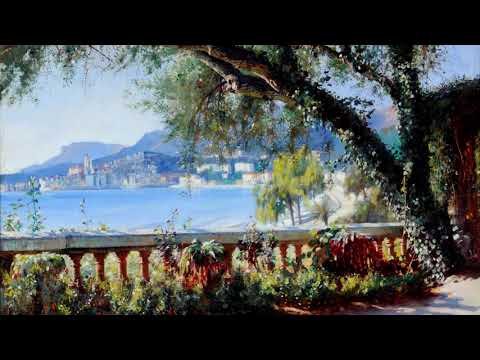
Welcome to Beverley Art Gallery’s Mindful Art Engagement series — the series that invites you to be with art differently. To linger for longer, and to take time to check in with your internal world as you spend some time being and breathing with art, curious to find out what each painting evokes in you. As always, there is no right or wrong way to engage with these practices. You are simply invited to bring a playful curiosity to each practice, and we would love you to share your experiences with us. Following each guided viewing, Helena Cox, our Curator, will be on hand to tell us more about each work of art. So just for now, when you're ready, take a moment to let your body become still. Feeling the weight of the body dropping straight down, all the way to the centre of the earth. Perhaps closing your eyes and allowing them to fully relax. Gently moving your attention to the breath, resting your attention here, following each in‑breath and each out‑breath. If you become distracted, it’s no problem at all — simply noticing this and beginning again in this moment. Coming back to this breath. This breath. And now, when you're ready, opening your eyes and coming to view the painting in front of you. Let’s begin by inviting the eyes to scan over the entire scene — not stopping, just gliding, and noticing how it is to do this. Are the eyes drawn to move in a certain way, or is it quite random? Just being curious. Now, slowing down the eye movement, and seeing if it is possible to take in the whole painting at once — as if you were sitting on a bench, taking in the view. Noticing your breath and being aware of breathing and sitting here, right now, drinking in this view. Perhaps imagining the smells and sounds of this place as you sit. The temperature of the air. The pace of life. Just allowing yourself to rest here. When you're ready, exploring the foreground in detail. Perhaps tracing the whole balustrade with your eyes. Noticing how the light reflects off the top. How the shadows dance there, perhaps imagining how it might feel to the touch. Noticing the columns and the planted border. What colours are here? Can you see any movement? Slowly gazing at the path and the shadows, and allowing your eyes to be drawn to the tree in the foreground — zooming in close to its details. Noticing individual leaves and branches. Perhaps imagining how it might feel to the touch. Noticing the size of the tree, the weight of its branches, and its hidden roots. And here we are — sitting and breathing with this tree, fully present. Allowing your gaze now to move to the mid‑ground — to the bright green trees, the bay, and the beach. Noticing if your body or mind has any response to contemplating the water and the sand. Perhaps a faint longing, or reminiscing. Perhaps a feeling of relaxation — or perhaps indifference. There is no right or wrong way to feel — simply noticing how it is to contemplate this scene. When you're ready, exploring the far shore and the settlement here, and the furthest hills. Perhaps you feel a pull toward the town — or perhaps you are content to view from a distance. Simply noticing what is here for you right now. Taking a deeper breath in now and returning to our starting point — sitting on the bench, allowing the gaze to move freely around the scene. Noticing if this place feels more familiar now. Noticing how — in order to get to know a person, a place, or a piece of art — all we have to do is be present, curious, and willing to listen to what it has to say to us non‑judgmentally. Feel free to pause this recording to continue your exploration of the work, and when you're ready, press play again — or simply continue listening to hear Helena Cox tell us more about the artist and this piece.

This painting is among the most colourful and vibrant works in Beverley Art Gallery’s collection. Together with another set of paintings, it forms part of the so‑called Champney’s Bequest. John Champney, the Gallery’s founder and Beverley’s much‑loved benefactor, was instrumental in establishing the gallery in 1910 and supporting its extension in 1928. Aside from Beverley, Champney spent much time in London — especially at the Fine Art Society, a key institution in the development of British art at the turn of the century. Many of Champney’s paintings were purchased during his time with the Society, and it is clear that his collecting focused on up‑and‑coming contemporary artists of the time. The Mediterranean painting we have just explored was first exhibited at the Fine Art Society in 1891 and praised for its captivating subject, which appealed to many visitors. Champney — like his friend, the painter Fred Elwell of Beverley — was well‑travelled and had a fondness for French, Italian, and Swiss landscapes. This sunlit painting is filled with the energy of summer, with its crystal‑clear skies, light‑blue sea, and bright, fresh greenery. The composition invites us to imagine ourselves stepping right into the picture and walking along the overgrown balustrade towards the sunny beach — with a smile on our face and not a worry in sight.

Elevenses
Elevenses

Welcome to Beverley Art Gallery’s Mindful Art Engagement series — the series that invites you to be with art differently: to linger for longer, and to take time to check in with your internal world as you spend some time being and breathing with art, curious to find out what each painting evokes in you. As always, there is no right or wrong way to engage with these practices. You are simply invited to bring a playful curiosity to each one, and we would love you to share your experiences with us. Following each guided viewing, Helena Cox, our Curator, will be on hand to tell us more about each work of art. For now, when you're ready, take a moment to let your body become still. Feeling the weight of the body dropping straight down, all the way to the centre of the earth. Perhaps closing your eyes and allowing them to fully relax. Gently move your attention to the breath. Rest your attention here, following each in‑breath and each out‑breath. If you become distracted, it’s no problem at all — simply noticing this and beginning again in this moment. Coming back to this breath. This breath. And in your own time, opening your eyes and coming to view the scene in front of you. As you begin this period of slow looking, just checking in to see whether you have any immediate response to this painting — any likes or dislikes. Not judging your experience — simply being curious about how you are feeling right now. Letting go of any judgements with each outward breath. And coming to view the painting anew, this time in terms of colour and shape. Perhaps beginning by noticing all the straight lines that are here, tracing them with your eyes. Noticing all the straight‑edged shapes. How is it to notice this? Now purposefully picking out the curved lines, the rounder shapes — allowing yourself to focus on these for a while. When you're ready, bring your attention to colour. What are the predominant colours in this painting? Choosing one colour now and noticing all the places it appears. Choosing a different colour and allowing it to reveal different parts of the scene to you. Being interested in light — where are the brightest, lightest parts of the painting? Noticing the darkest and dullest places, and the contrast between the two. Coming now to view the room as a whole — noticing its dimensions, the feel of it. Can you imagine the temperature inside the room, the sounds and the smells that might be here? Very slowly and deliberately, rest your eyes on individual items in the room. Choosing an item, noticing its shape, colour, texture, and imagined weight. Pause the recording if you wish, to give yourself time to really look around and see what’s here. And when you're ready, coming to contemplate the people in the room. Noticing how each one is sitting or standing — the placement of their hands, their expression or mood. You may wish to play by imagining being each of the characters in turn — seeing how it feels to be in that room, in that body, with those people. What emotions might each one be feeling? Take your time to play with this idea if you choose. And when you're ready, bring your attention specifically to the man in the centre. Perhaps noticing how your eyes — and the eyes of the women surrounding him — are drawn towards him. Being interested in what this brings up for you. Simply noticing your response and any stories that might be arising without judgement. Taking time now to reconnect with the breath in the body — feeling your feet on the floor, noticing how you are feeling right now. And as you continue to contemplate this painting, here is Helena with more information:

Fred Elwell is Beverley’s most beloved painter. Born in 1870, he continued producing art actively until his death in 1958. Elwell studied in Antwerp and Paris, but returned to Beverley after completing his studies abroad. Although he travelled widely — painting landscapes from across the Continent — his heart belonged in Beverley, the market town he captured in many of his finest works. As a local figure, Elwell was well known among townsfolk, and many of his friends and neighbours modelled for him, taking on various roles throughout his paintings. Elevenses was part of a series exploring life behind the scenes at the popular local restaurant, the Beverley Arms. Elwell began this series in 1919, but Elevenses was only completed in 1940 — showing his long‑term dedication to documenting the daily work of cooks and maids in Beverley’s establishments. The cook in this painting was modelled by Eliza Barrow, a cleaner who worked for the Beverley Library and Art Gallery for more than 30 years. The other figures were all modelled by local young women working as maids or cooks throughout Beverley. In this work, Elwell created a nostalgic, idealised scene, drawing on his fame as a still‑life painter — something we see in the detailed rendering of the raw fish, the pheasant feathers, and the meticulous interior of the Georgian townhouse. But above all, Elwell wanted to capture a moment of joy — a simple break in the working day: sharing a brew with friends, chatting over biscuits, and enjoying a small, pleasurable moment amid the hustle and bustle of daily life — an art we could all benefit from embracing.

Dutch Fishmarket
Dutch Fishmarket

Welcome to Beverley Art Gallery’s Mindful Art Engagement series — the series that invites you to be with art differently. To linger for longer, and to take time to check in with your internal world as you spend some time being and breathing with art, curious to find out what each painting evokes in you. As always, there is no right or wrong way to engage with these practices. You are simply invited to bring a playful curiosity to each practice, and we would love you to share your experiences with us. Following each guided viewing, Helena Cox, our Curator, will be on hand to tell us more about each work of art. So just for now, when you're ready, taking a moment to let your body become still. Feeling the weight of the body dropping straight down, all the way to the centre of the earth. Perhaps closing your eyes and allowing them to fully relax. Gently moving your attention to the breath, resting your attention here — following each in‑breath and each out‑breath. If you become distracted, it’s no problem at all. Simply noticing this and beginning again in this moment. Coming back to this breath. This breath. And now, when you're ready, opening your eyes and allowing your gaze to move freely over this particular work of art. Letting the eyes relax and loosely float around the painting — not focusing on anything in particular, just covering the surface with your attention. When you're ready, bring your attention to colour. How many colours can you see here? What do you notice about the colour palette — is it broad and varied, or quite narrow? Taking your time to notice each colour in turn. Bringing your attention now to areas of light and brightness. Seeing if you can find the brightest spot. And noticing areas of shade and darkness, and the contrast here. When you're ready, taking some time to notice shapes. Perhaps choosing one shape you can see and tracing the outline of it slowly with your eyes. Taking your time. Now stopping, taking a deeper breath, and letting your gaze settle in one place. Keeping some of your attention on the breath, allowing yourself to take in some of the finer details of this scene. Taking your time to look closely at one particular area. What do you notice here? Moving your attention to the figures in the painting. What strikes you about this group of people? What might they be doing? Why might they be gathered here? And as you sit breathing with the painting, simply allowing stories and imaginings to arise and fall away again with each inward and outward breath. Being interested in the buildings and the street — what kind of place is this? And when you're ready, if you wish to do so, perhaps imagining that you can enter the painting — either invisibly, or perhaps dressed in similar clothing. Mingling with the people here, being one of the crowd, breathing as you move around the scene. How might you feel in these clothes? What sounds might you hear? How is the temperature of the air on the skin? And what smells might be coming to you? As you imagine walking around in this scene, allowing it to come to life in your imagination. When you're ready, imagining you can change into a bird and fly up high into the sky here — looking down at the scene, noticing the rooftops and the light. What else might you be able to see? And as you take a deeper breath in, feeling your body in the chair and coming back to being the observer of this painting again. What do you notice now? How do you feel about this painting, having immersed yourself fully in it? Noticing if there is anything to be gained from having a change of scene — even if only in your imagination. If you feel it might be helpful, how might you bring about a change of scene or perspective in your day‑to‑day life? Perhaps sitting in a different chair, looking out from a different window. Feel free to pause this recording to carry on with your exploration of the artwork, in whatever way you like. And when you're ready, press play again — or continue listening now to hear Helena Cox tell us more about the artist and this work.

This Dutch painting from 1873 is a bit of a mystery! It has been part of Beverley Art Gallery’s collection for many years, but there is very little documentation about how it arrived here. We don’t know who owned the work before us, or how it travelled from the Netherlands to Beverley. The artist himself is also a mysterious figure. There is only one work by him in any UK public art collection — which makes it even more intriguing to ask who the painter was, and how this picture found its home in Beverley. One possible reason lies in the East Riding’s close historic links to the Netherlands, which led to the establishment of a large Dutch community in Hull in the 19th and early 20th centuries. You can find more about these connections in a permanent display in our Treasure House Museum. One of the greatest influences of Dutch culture was its architecture. You can see several exquisite townhouses in the background of this painting. Some of these architectural features had an impact on Beverley and Hull, where houses inspired by Dutch design can still be seen today. This painting transports us to a different time and place — and although it was painted in the 19th century, it depicts a historic scene that echoes the 17th‑century golden age of Dutch painting. Taking us on a journey across time and across the world is, after all, one of the most uplifting features of art.

Be happy and well

Want to find more ways to improve your wellbeing? Visit East Riding Health and Wellbeing and search for nearby groups and clubs for sports, activities, creativity and learning new skills. Find local and national services for your health, such as dementia support at home, anxiety and stress, help to quit smoking, losing weight, how to improve wellbeing in the workplace and much more.

Visit HappyAndWell.Me

Libraries

Visit the East Riding Libraries health zone to find even more wellbeing groups and events. Borrow books on prescription for free with your library membership, helping with a range of topics including dementia, anxiety, pain management, and more.

Visit East Riding Libraries